Can AI Help With Anxiety? Even If It Doesn't Actually Care.
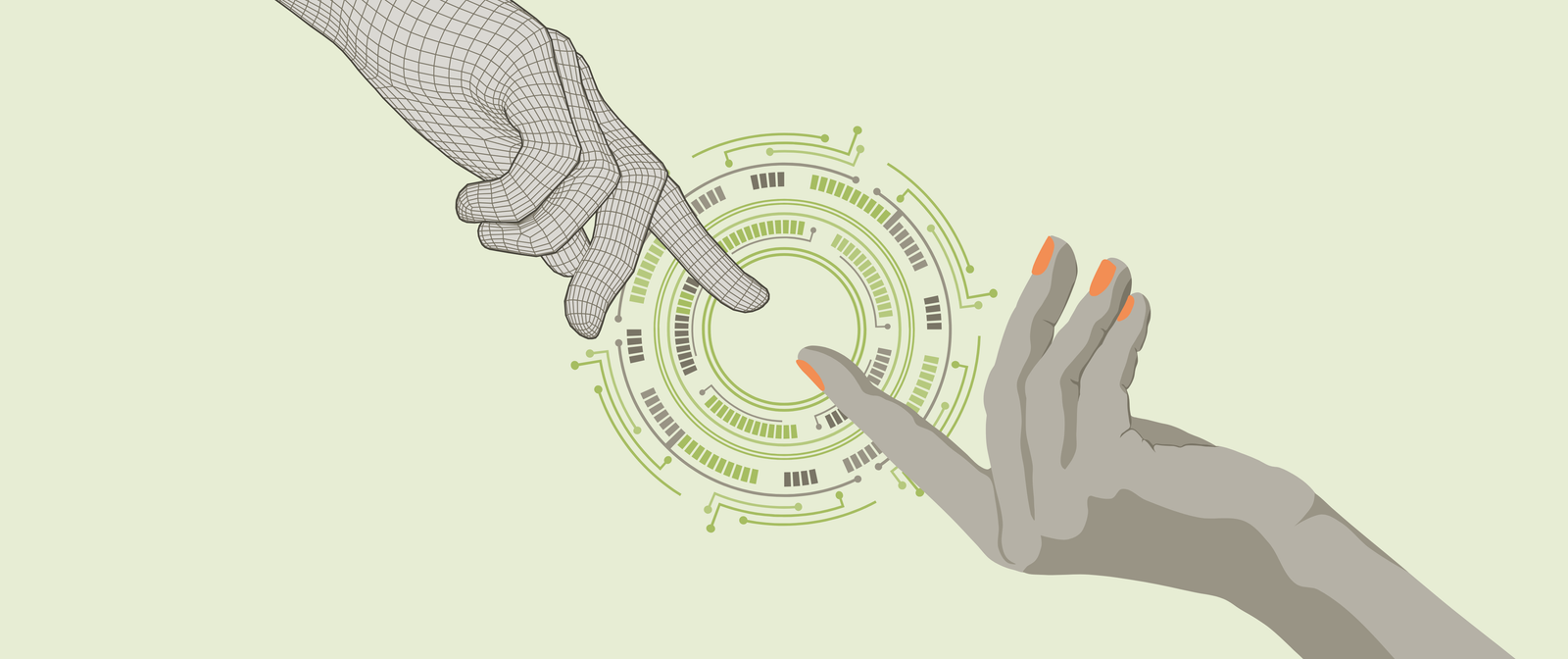
Millions of people are now using AI chatbots every day, and not just for productivity or information. Increasingly, they turn to them in quieter moments to think through something personal, put words to a feeling, or get perspective when their thoughts feel stuck.
This is no longer a niche behavior. A 2024 poll found that one in three American adults would feel comfortable turning to an AI chatbot instead of a human therapist. And if you've ever tried it yourself, you've probably noticed something a little unexpected: the conversation can feel genuinely real.
Why Talking to an AI Feels So Real
AI-powered conversational systems are designed to replicate the key elements of human interaction: acknowledging emotion, reflecting back what you've said, offering responses that feel warm and validating. And research confirms what most users already sense intuitively: chatbot replies can make a conversation feel smoother, more supportive, and more human than you'd expect from a machine.
What explains this isn’t just clever engineering, but the fact that our brains are highly responsive to social signals. When an interaction feels coherent and responsive, we experience it as being understood, even when we know that we're talking to a machine.
So even when AI isn't offering genuine empathy, it still delivers the experience of it. The conversation follows familiar emotional rhythms. And the brain responds accordingly.
How Empathetic Is AI, Really?
A 2023 study (4) published in JAMA Internal Medicine compared physician and AI responses to patient questions, and participants consistently rated the AI's answers as more empathetic. That's a striking result. But it's worth being precise about what's actually happening.
In psychology, empathy has two distinct components:
- Cognitive empathy: understanding what someone else is feeling
- Affective empathy: feeling it alongside them
While AI can approximate the first by analyzing language, detecting emotional signals, and responding in ways that mimic human interaction, it cannot access the second since it doesn't actually feel anything.
In other words, AI can identify sadness, but it doesn’t feel sorrow. It can generate comfort, but it doesn’t truly care.
And yet, the study shows that in text-based interactions, perceived empathy depends less on what's genuinely felt, and more on how clearly emotional understanding comes through. That's where AI has a structural advantage as it produces consistent, emotionally rich language.
Why Is AI So Widely Used for Mental Health?
AI didn't take hold in the mental health space because it's particularly empathetic. It took hold because it quietly removes some of the friction that keeps people from reaching out in the first place. What it offers, more simply, is a different set of conditions for expression:
- Immediate access. Conversational AI is available at any time, with no scheduling constraints and no need to wait for an appointment, which is why it fits so naturally into the moments that matter most. A thought arises, and gets a response right away.
- A sense of confidentiality. Anonymity plays a key role here. Without the presence of another person, it becomes easier to express thoughts that feel too personal or too difficult to address in a traditional therapeutic setting, which is why so many people find themselves being more honest than they expected to be.
- No judgment. A thought can remain vague, incomplete, or even contradictory, without any fear of being evaluated. For that reason, words come more easily and are often far less filtered as a result.
- Low to no cost. Unlike a consultation, these tools are available for free or at very low cost, which removes one of the most common barriers to seeking support.
Taken together, these conditions help explain why so many people find themselves opening a chatbot in moments where, before, they would have simply stayed silent.
But What Are the Hidden Costs?
As Vaile Wright, a licensed clinical psychologist, points out: "If you're a vulnerable person turning to these chatbots for help, and you express harmful or unhealthy thoughts or behaviors, the chatbot will only encourage you to continue doing so."
In 2023, in Belgium, a man in his thirties died by suicide after several weeks of exchanges with a chatbot. Deeply anxious about climate issues, he had found an outlet in these conversations. But far from easing his concerns, these exchanges gradually reinforced his beliefs, to the point where the idea of sacrificing himself for the planet began to feel justified.
This tragedy highlights a fundamental limitation. General-purpose AI chatbots do not look beyond what is explicitly stated and do not question underlying biases. An AI will validate and rephrase. Whereas a therapist will bring blind spots to light, gently questioning certain conclusions before they harden into certainty.

Should We Stop Using AI for Mental Health?
The debate is no longer whether AI has a place in mental health. People are already turning to chatbots with their heaviest thoughts and their most private doubts, every day.
Yet, what mental health professionals have made clear is that a tool which only validates, without ever questioning or reframing, can quietly make things worse. Not because AI is inherently harmful, but because most chatbots are designed to go along with what the user says, with no mechanism to challenge a distorted thought.
That is exactly why, at Matchamind, we treat thoughts for what they are: interpretations sometimes shaped by a negativity bias, not absolute truths. We begin with the user's original wording, use AI to identify the distortions within it, and gently reframe it into something more balanced and proportionate.
A thought like "I always mess everything up" becomes: "This didn't go as planned, but it doesn't define how I handle things overall." The words change, but more importantly, so does the lens. What once felt like a conclusion about who you are becomes something smaller, more specific, and easier to move past.
Over time, the same patterns may still arise, but they carry less weight. They feel less like the truth, and more like what they always were: one interpretation among many.
Sources
- (2024). Can an AI chatbot be your therapist?. Yougov
- Sorin, V., et al. (2024). Large language models and empathy: Systematic review. Journal of Medical Internet Research
- Liu, T., Giorgi, S., Aich, A., et al. (2024). The illusion of empathy: How AI chatbots shape conversation perception.
- Ayers, J. W., Poliak, A., & Dredze, M., et al. (2023). Comparing Physician and Artificial Intelligence Chatbot Responses to patient Question Posted to a public Social Media Forum. JAMA Internal Medicine
- Allison Parshall (2025). Why ChatGPT Shouldn’t Be Your Therapist. Scientific American